


Informal Settlements Generate Collective Empowerment through Locally Led Action
Hosted by the Cornell Mui Ho Center for Cities, Shiela Muganyi — a community research leader from the Zimbabwe Homeless People's Federation and a member of Slum Dwellers International in Zimbabwe — visited AAP to share how mutual exchange and planning for the future can improve the lives of residents in informal settlements.
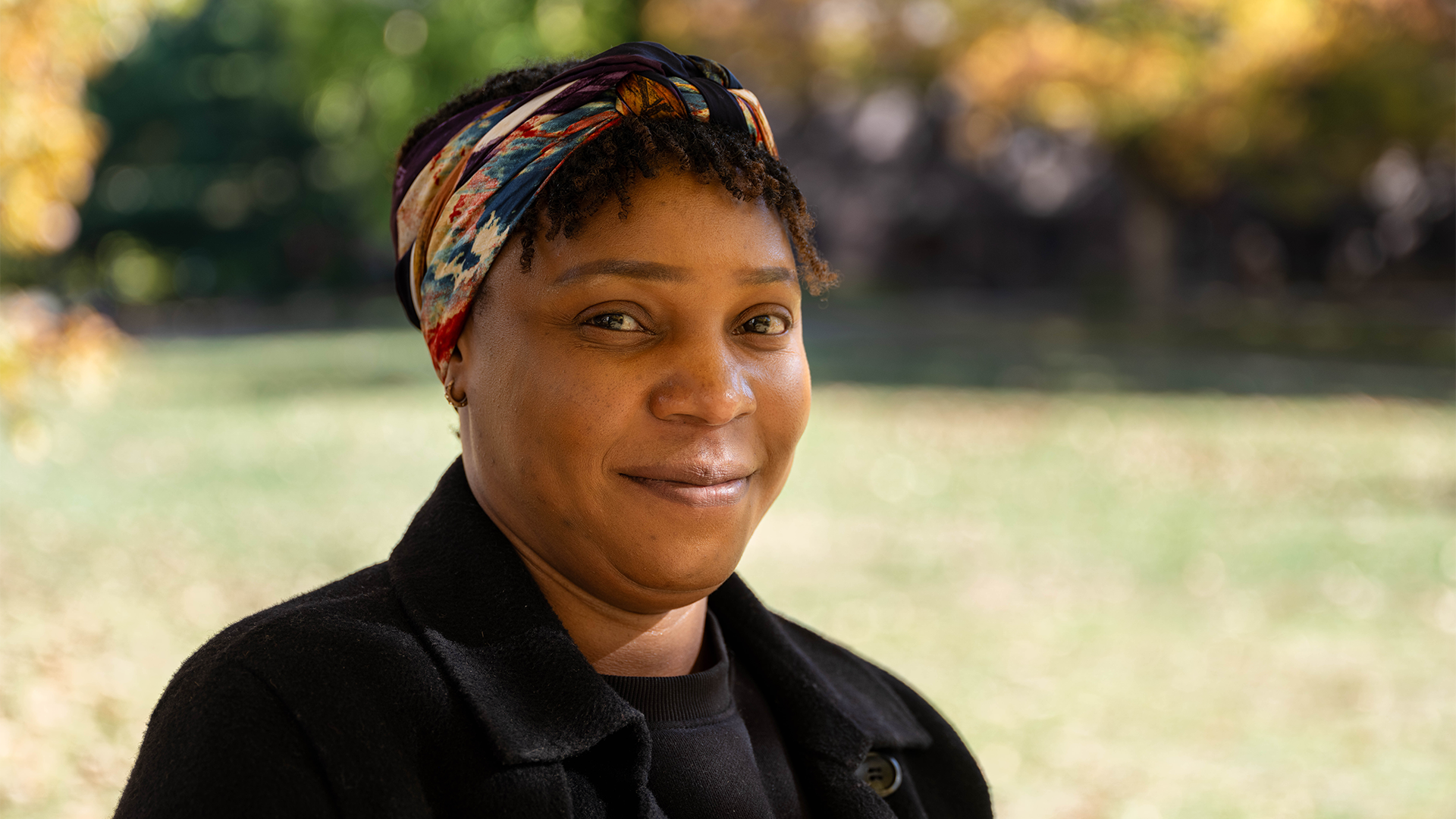
Shiela Muganyi, community research leader at the Zimbabwe Homeless People's Federation and member of Slum Dwellers International–Zimbabwe, visited AAP to share information about the importance of settlement upgrading with Architecture Assistant Professor Felix Heisel's Informal Futures studio. Anson Wigner / AAP
Further strengthening their ongoing collaboration with Slum Dwellers International (SDI), which has affiliates in more than 30 countries across Africa, Asia, and Latin America, the Cornell Mui Ho Center for Cities at the College of Architecture, Art, and Planning (Cornell AAP) hosted Shiela Muganyi from SDI–Zimbabwe this semester. Her visit included supporting the Informal Futures studio with Architecture Assistant Professor Felix Heisel as well as leading seminars, giving lectures, and meeting with AAP students and faculty. Muganyi shares her perspective on the impact of SDI's work, including the organization's successes and challenges, as well as the value of sharing resources across settlements, cities, and communities to increase access to basic amenities and improve living standards.
Could you describe where you grew up and what some of the biggest challenges you faced were?
I grew up in an informal settlement called Dzivarasekwa in Harare, Zimbabwe, where there is a lack of access to basic services such as water, sanitation, education, and housing. We rented one and a half rooms in a property that did not belong to us. When I was young, my mom had a stroke, and then my dad decided to leave us. My mom was bedridden, so I had the responsibility of taking care of her doctor's check-up every month. I had to drop out of school after my father, our family's only sole provider, left us. With no one else to support us, we couldn't afford my or my siblings' school fees, and I had to learn how to do hair so we could survive. I needed to provide food and pay school fees for my three younger siblings. It was very difficult, heading the household as a child.
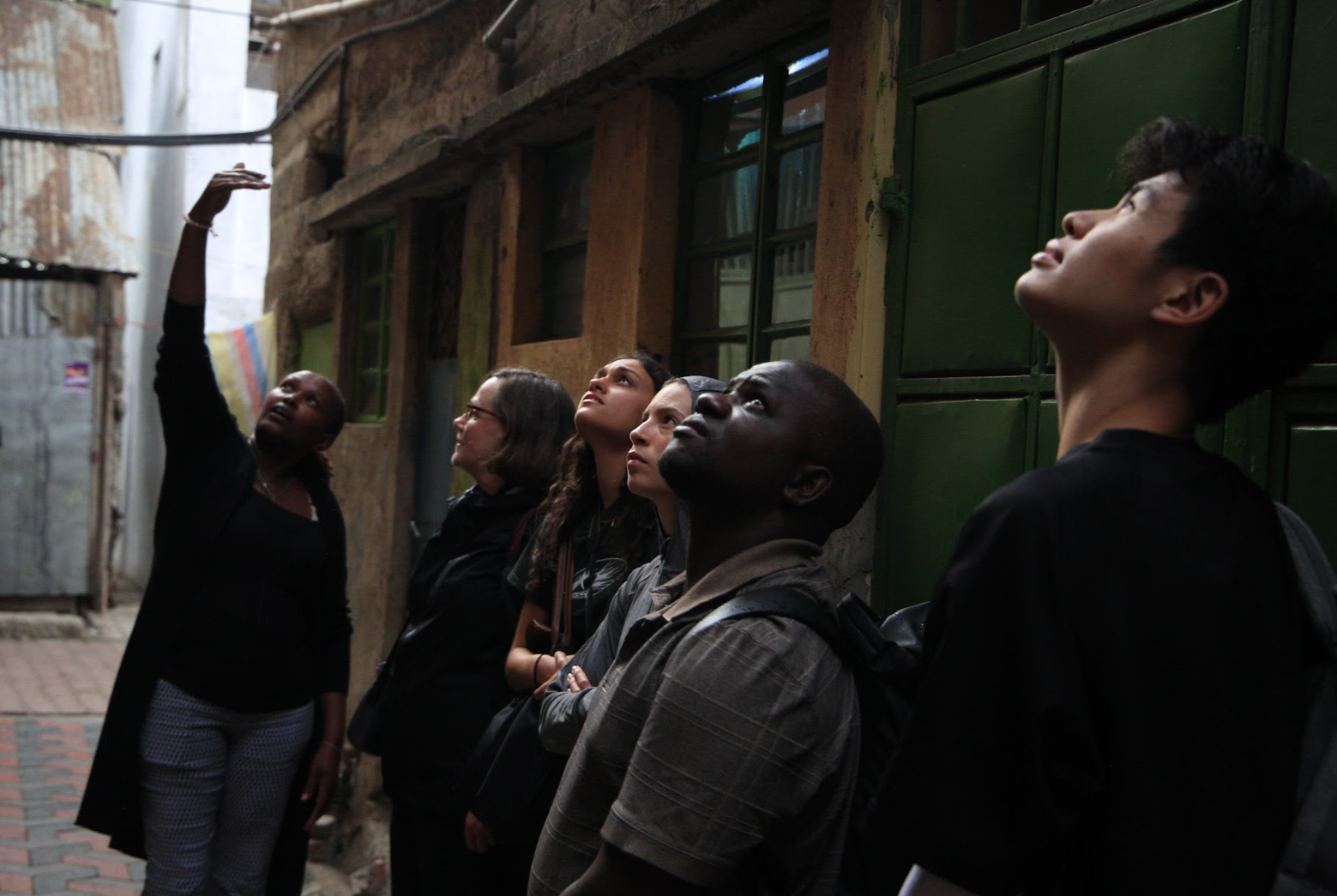
A Muungano representative, CRP Chair and Professor Sophie Oldfield, Ingie Yasser El-Khazindar (B.Arch. '26), Pia Cortes-Guerrero (B.Arch. '27), Mike Wera (SDI), and Stephen Zhuang (B.Arch. '27) observe structures in Kambi Moto, an upgraded informal settlement in Nairobi, Kenya, as part of an ongoing partnership between the Center for Cities and SDI. image / provided
What is your current role with Slum Dwellers International, and how did you come to work with them?
At Dzivarasekwa, some of my mom's friends said it was not fit for a sick person to be staying in such a situation and told her about Slum Dwellers International (SDI). My mom was very interested, but she could not walk or attend the organization's weekly meetings, so I went in her place and was the youngest person there. I grew to love the environment. I became a member of the saving scheme. They were very supportive and gave me a small amount of money to buy sweets and snacks to sell, to help generate more income while I was doing hair.
I started my journey with the Slum Dwellers International network as a community mobilizer. In SDI, we focus on community savings groups as the main way to organize and support urban poor communities. Through these savings groups, we supported communities in coming together, strengthening their collective voice, and engaging meaningfully with local authorities.
In Zimbabwe, this approach led to the establishment of city funds that support community-led upgrading. One of the first projects was the Harare Slum Upgrading Finance Facility, a collaboration between the Zimbabwe Homeless People's Federation, Dialogue on Shelter, and the City of Harare. I was among the pioneering loan officers for this initiative and also trained others as the model scaled up to other cities.
Over time, I also became interested in data collection, enumeration, and mapping. I ended up leading SDI's regional data collection team in Harare, and then the national Zimbabwe enumeration team. I was particularly interested in community research and understanding the issues faced by different types of informal settlements, as I was also part of an informal settlement myself. I was keen to know their experiences and also to learn about solutions. We ended up having settlement exchanges, city-to-city exchanges, and learned from each other to improve our settlements. Currently, I'm also doing a lot of research on climate change vulnerability assessments.
Could you speak a little bit more about your current work and what you're researching?
Currently, I work as a researcher, focusing on documenting and analyzing community experiences to inform policy and practice within SDI's broader network. My work now bridges community-level action and evidence generation, helping ensure that local innovations shape urban resilience and inclusive development.
Under the African Cities Research Consortium (ACRC), we're implementing three projects in Harare, focusing on upgrading informal markets, waste management, and climate change actions, among others, to strengthen the federation and broader slum upgrading. I'm actively involved across all these projects, supporting both community processes and research components.
Our work focuses on understanding and addressing the vulnerabilities that urban poor communities face, including flooding, heat, drought, strong winds, and challenges related to waste management and infrastructure. We recognize that communities often can't wait for local authorities, NGOs, or other actors to intervene, so our approach is to empower residents — especially women and youth — to lead local adaptation and resilience efforts.
We promote locally led adaptation actions, such as planting trees to reduce the effects of strong winds and extreme heat, establishing community gardens to enhance food security, and supporting communities to build more resilient housing and infrastructure that can better withstand climate stresses.
At the same time, we encourage community savings for climate resilience. While savings schemes have traditionally supported access to water, housing, and livelihoods, we're now motivating communities to save specifically for climate adaptation, ensuring they are better prepared for future shocks.
A key part of our work also involves supporting women and youth to take active roles in community resilience hubs. These hubs are becoming vital spaces for knowledge sharing, peer learning, training, waste management, recycling, and local innovation, strengthening community capacity and advancing inclusive, community-driven climate action.
How does your experience living in an informal settlement inform the way that you work and the way that you engage with the communities?
Living in an informal settlement has deeply shaped how I work and engage with communities. I've experienced firsthand how informal settlements are often seen only through a negative lens: when a crime is committed, the police begin their investigations there; when evictions or demolitions are planned, these areas are targeted first. And when city planning discussions take place, the voices of informal residents are rarely included.
So when I joined the Slum Dwellers International network, I already knew how important it was to make places where people from informal settlements could organize to have their voices heard. During our first data collection in Crowborough North, I realized how useful community data could be in helping us push for change. We shared our data findings with the local authority, which led to the allocation of land to more than 200 families. For me, that was a game-changer; it changed everything, seeing communities once called "illegal" now recognized and supported with safe rights to their land.
In Zimbabwe, owning land makes you feel like you belong and gives you pride. It means you can start accessing basic services such as water, sanitation, and decent housing. As someone who now owns a small piece of land, I know what that means for feeling safe and hopeful. That personal experience drives everything I do, keeping me connected to the challenges and dreams of the communities I work with.
Each time I think of my mother, who was bedridden for years, I remember why I kept going to my savings scheme (Chatagwinyira) meetings every Saturday. That discipline and collective spirit have shaped my values and my commitment to continue organizing, supporting, and amplifying the voices of informal settlement communities.
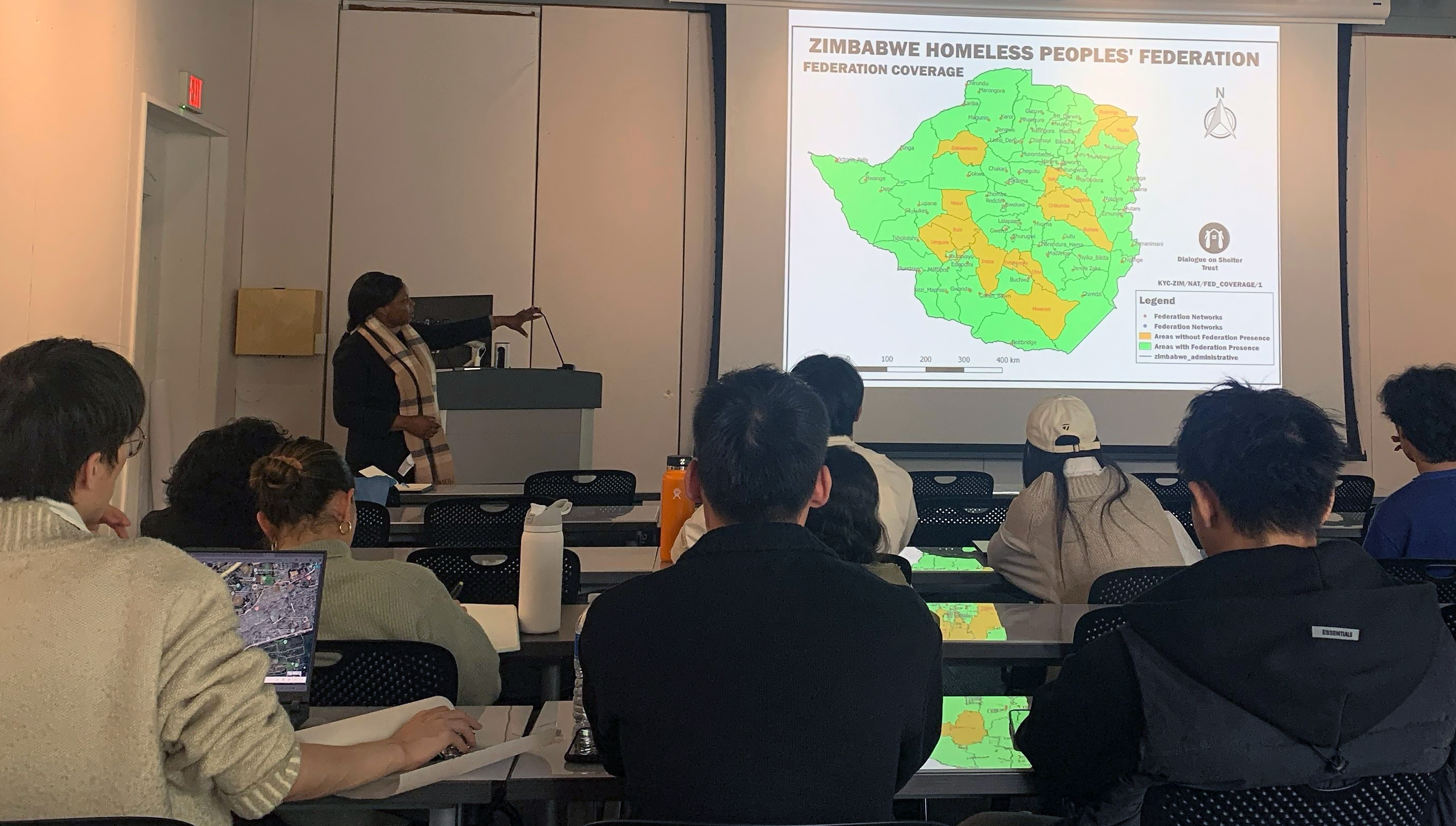
Shiela Muganyi presents her research and the work of SDI–Zimbabwe on informal settlement upgrading with Assistant Professor of Architecture Felix Heisel's Informal Futures studio. photo / Claire Fisher
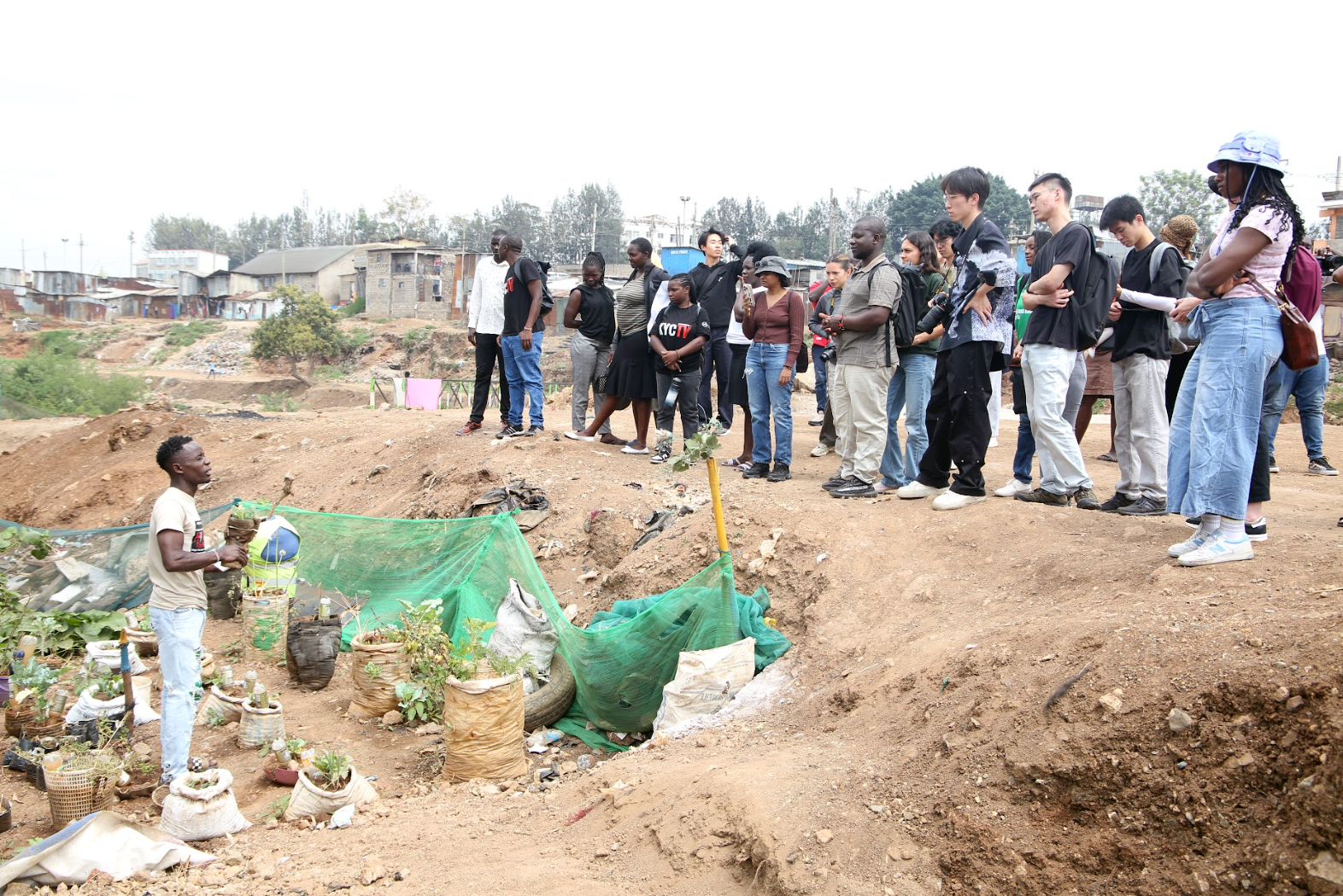
AAP students learn from residents about community-led urban agriculture efforts in Mathare, an informal settlement in Nairobi, Kenya. image / provided
What are the resilience hubs, and how do they help people work toward addressing some of the main challenges of living in informal settlements?
The main purpose of these hubs is to share experiences, to share ideas. It's a knowledge-sharing hub where people come together, talk, and facilitate learning across settlements. The hubs are central to the SDI model's core financial strategy, providing the location where communities "do their savings." These collective savings are pooled into community development funds used to finance local upgrades and provide a base for leveraging formal climate or municipal finance. These hubs actively support informal livelihoods, particularly waste management. They are called a recycling hub. They serve as designated sites for waste pickers to come, separate, sort, and wait for buyers, formalizing a critical component of waste management in Zimbabwe. We also use them for local adaptation actions like tree planting, nurseries, and community gardens. Crucially, hubs are also used for data and planning centers and often serve as the physical base for community-led processes such as city-wide enumeration and mapping. The data produced is vital for engaging local authorities and negotiating for better services and tenure security.
When you think about your future work with SDI and with communities, what are some of the main things you hope to work toward or achieve?
When I think about the future, my biggest hope is to support and guide the next group of leaders in the SDI network, to help create more "Shielas" who will keep this movement going. I want to see more young people, especially women, stepping into leadership roles, helping organize communities, shaping policy, and changing lives.
For me, it's not just about the work I do today, but about building continuity, knowing that even when I'm no longer here or not involved, others have the same passion, values, and dedication to supporting communities to achieve growth. That's the legacy I want to leave: a movement that remains strong, inclusive, and able to keep going on its own.
Is there something you've accomplished through your work with SDI that you hold close in your work now and going forward, something that inspires you or was so remarkable that it stays top of mind?
I told you about my lack of access to basic education. I continued with my meetings with the federation and my volunteer work. When I became a loan officer, this was the chance for me to go back to school to enhance my research with SDI. Now, I'm a proud holder of a Bachelor of Arts Honours Degree in Development Practice from Midlands State University in Zimbabwe. When it was very hard for me in terms of school fees, my colleagues from SDI would chip in. They would surprise me and just give me an envelope. So this is something that holds my heart. I achieved what I really wanted because of Slum Dwellers International. Right now, I'm trying to pursue a master's degree. If I have any scholarship, I'll definitely jump for it.


